Most people miss their fibre. What 25 g a day looks like
Most adults eat less fibre than recommended, and "fibermaxxing" has made it a trend. What 25 g a day looks like, and how to track it.
Calories, protein and sugar get most of the attention in food tracking. Fibre rarely does, yet it is the one most people fall short on. In 2026 it even became a trend: search interest in "fibermaxxing", a social media push to eat much more fibre, rose 115% over 90 days, according to Google search data reported by FoodNavigator [1].
In short: most adults are advised to eat at least 25 to 30 g of fibre a day, and most eat well under that. Getting there is usually a matter of a few swaps across the day rather than one special food, and it is best done gradually.
How much fibre the recommendations ask for
The figures differ a little by country, but they sit in the same range.
- The World Health Organization recommends that adults eat at least 25 g of naturally occurring dietary fibre a day, meaning fibre from food rather than supplements [2].
- The UK guideline is 30 g a day for adults. The NHS says most adults eat about 20 g [3].
- The United States recommends 25 g a day for women and 38 g for men. According to the US Department of Health and Human Services, as reported by UCLA Health, more than 90% of women and 97% of men fall short [4].
Where do numbers like 25 g come from? One source is a series of reviews published in The Lancet in 2019 and funded in part by the WHO [5]. It pooled 185 long-term observational studies and 58 clinical trials. In the observational studies, the people who ate the most fibre had a 15 to 30% lower risk of several conditions than those who ate the least, and the lowest risk was seen at 25 to 29 g a day.
What it cannot tell you. Most of that evidence is observational. People who eat more fibre differ in other ways too, so the studies cannot prove that fibre alone made the difference. The reviews also left out people who already had a chronic disease. A recommendation for a population is not a prescription for you.
What a day of fibre looks like
The NHS gives three example meals [3]:
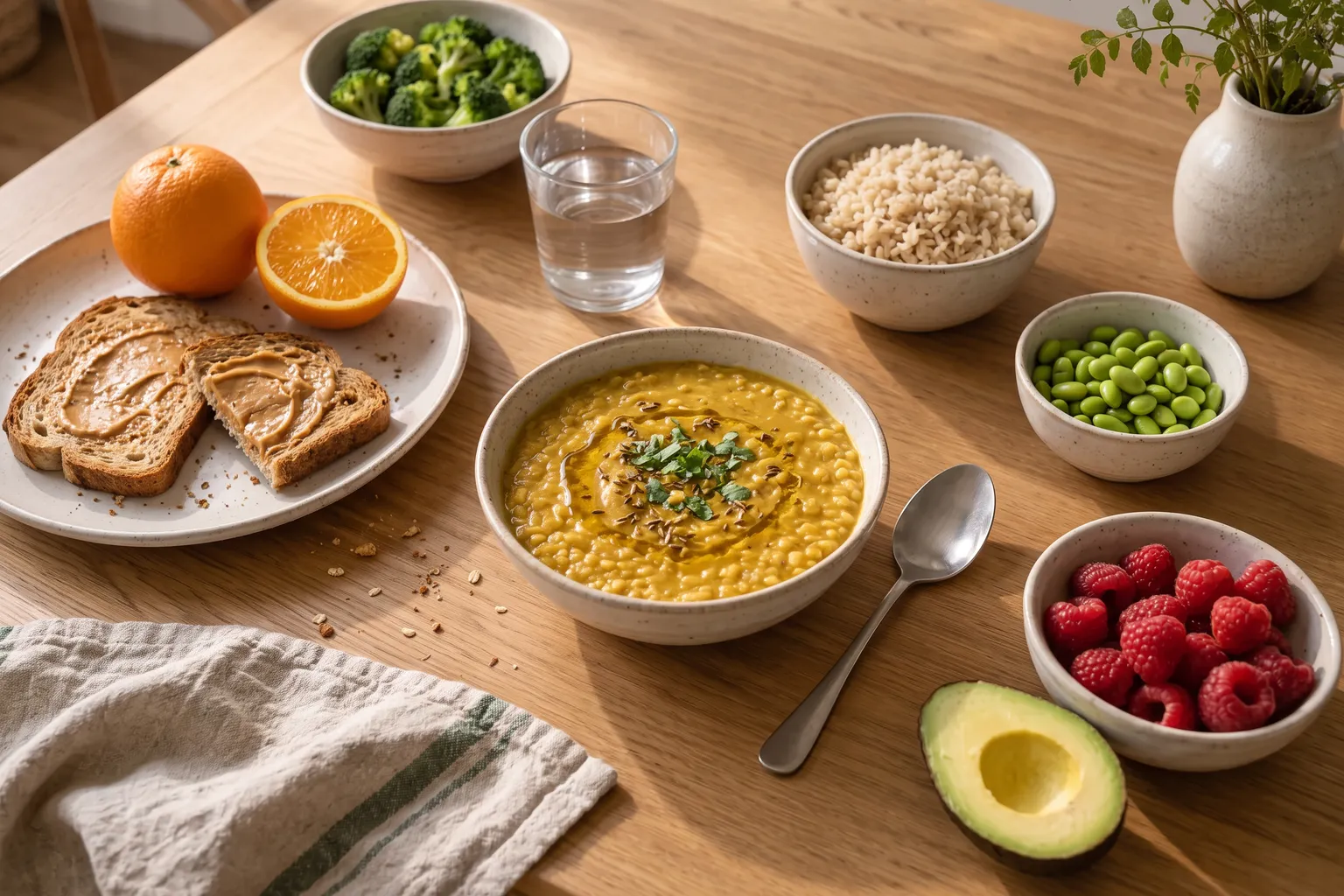
- Breakfast: two slices of wholemeal toast with peanut butter, then a medium orange. About 8.3 g.
- Lunch: wholemeal spaghetti with a lentil and tomato sauce. About 11 g.
- Dinner: grilled chicken breast, a skin-on baked potato, carrots and green beans. About 11.2 g.
That comes to about 30 g with no special products, mostly from swapping white bread and pasta for wholemeal, keeping potato skins on, and adding lentils.
A UCLA Health dietitian gives some single foods for comparison [4]: half an avocado has about 5 g of fibre, as does a cup of broccoli. A cup of raspberries has about 8 g, a baked potato about 4 g, and a cup of lentil soup about 8 g.
These examples come from British and American sources. The same approach works in any cuisine. The NHS suggests adding pulses (beans, lentils or chickpeas) to stews, curries and salads, choosing wholegrains such as brown rice, and including plenty of vegetables in sauces and curries [3]. Its own caution applies everywhere: the fibre in any food depends on how it is made and how much you eat, so treat every figure above as an illustration.
What fibermaxxing gets right, and the "too fast" problem
The trend points at a real gap, and dietitians mostly welcome it. The caution is about speed, not direction. The UCLA dietitian recommends increasing fibre slowly and drinking more water as you do. Going from "zero to 100", she says, leaves most people with some gas and bloating, and some with constipation if they don't drink enough [4]. She also suggests people with IBS, Crohn's disease or ulcerative colitis take care, and talk to a registered dietitian before eating much more fibre.
A sustainable version looks less like maximising and more like spreading: some fibre at breakfast, lunch, dinner and snacks, from a range of foods. The NHS makes the same point about variety [3].
Why fibre is hard to track
Fibre has a tracking problem calories do not: the figure is often missing. A label or database entry that lists calories may not list fibre, and a photo cannot see fibre at all. If an app treats a missing value as zero, your day looks worse than it was. If it hides the gap, you cannot tell a low day from an incomplete one.
How Senumi tracks fibre
- Fibre on every way of logging. Photo and text estimates, barcode, catalogue search, manual entry and saved meals all record total fibre in grams.
- A minimum, never a red line. The daily guide is 25 g by default, which you can change. It shows how much is left or that you have reached it. Being below it is never shown in red.
- Unknown is not zero. When a food has no fibre figure, Senumi records it as unknown and marks the day's total as partial ("At least 12 g recorded"). A partial day is never reported as a shortfall.
- Foods rich in soluble fibre are tagged. Oats, barley, legumes, apples and citrus are among them. If your goal is cholesterol or blood sugar, Senumi may suggest a soluble-fibre food as a habit tip, never as a promise of a result.
What Senumi does not do: it does not track soluble fibre in grams, because most food tables and labels do not carry it. And some foods in its catalogue have no fibre figure yet, so those days show as partial. For what the research says about fibre and lab results, see Meals and cholesterol and Meals and blood sugar.
Nothing here is medical or nutrition advice. If you have a digestive condition, are pregnant, take medication, or have a history of disordered eating, talk to your doctor or a dietitian before changing how much fibre you eat. Senumi's food figures, fibre included, are estimates.
Sources
- Crawford E. Is fibermixxing the new fibermaxxing? FoodNavigator-USA. 5 August 2026.
- World Health Organization. WHO updates guidelines on fats and carbohydrates. News release, 17 July 2023.
- NHS. How to get more fibre into your diet. Last reviewed 2 March 2026.
- Cohen S. Is 'fibermaxxing' a sound nutrition trend? UCLA Health. 6 January 2026.
- Reynolds A, Mann J, Cummings J, Winter N, Mete E, Te Morenga L. Carbohydrate quality and human health: a series of systematic reviews and meta-analyses. Lancet. 2019;393(10170):434-45.
This article is general health information, not medical advice. Senumi does not diagnose, treat, cure or prevent any condition. Talk to a qualified healthcare professional about your own situation.