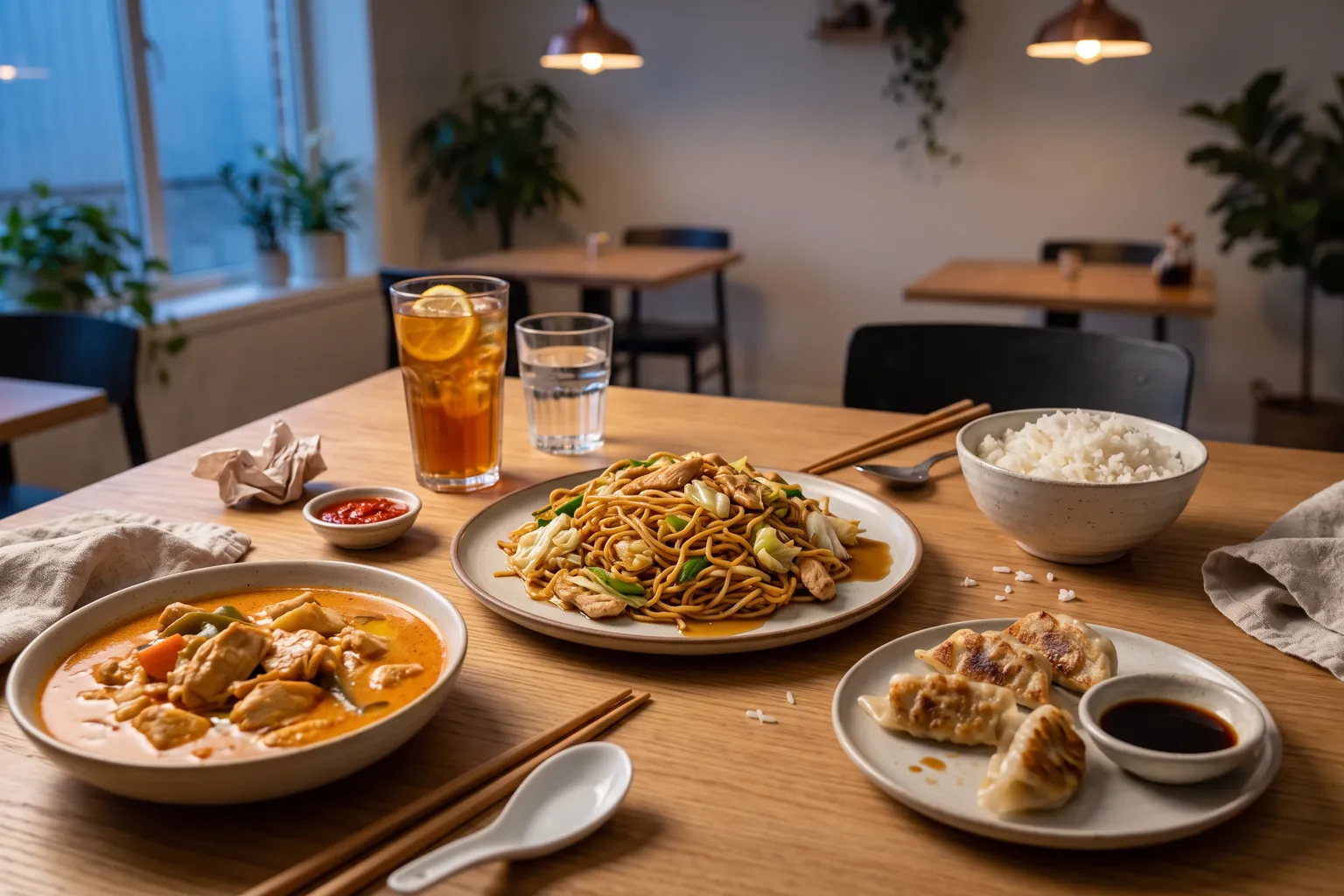
Why calorie apps struggle with pho, curry and other mixed dishes
A 2024 study tested 18 nutrition apps on Western and Asian meals. Mixed dishes were where they went most wrong. Here is why, and how to log them better.
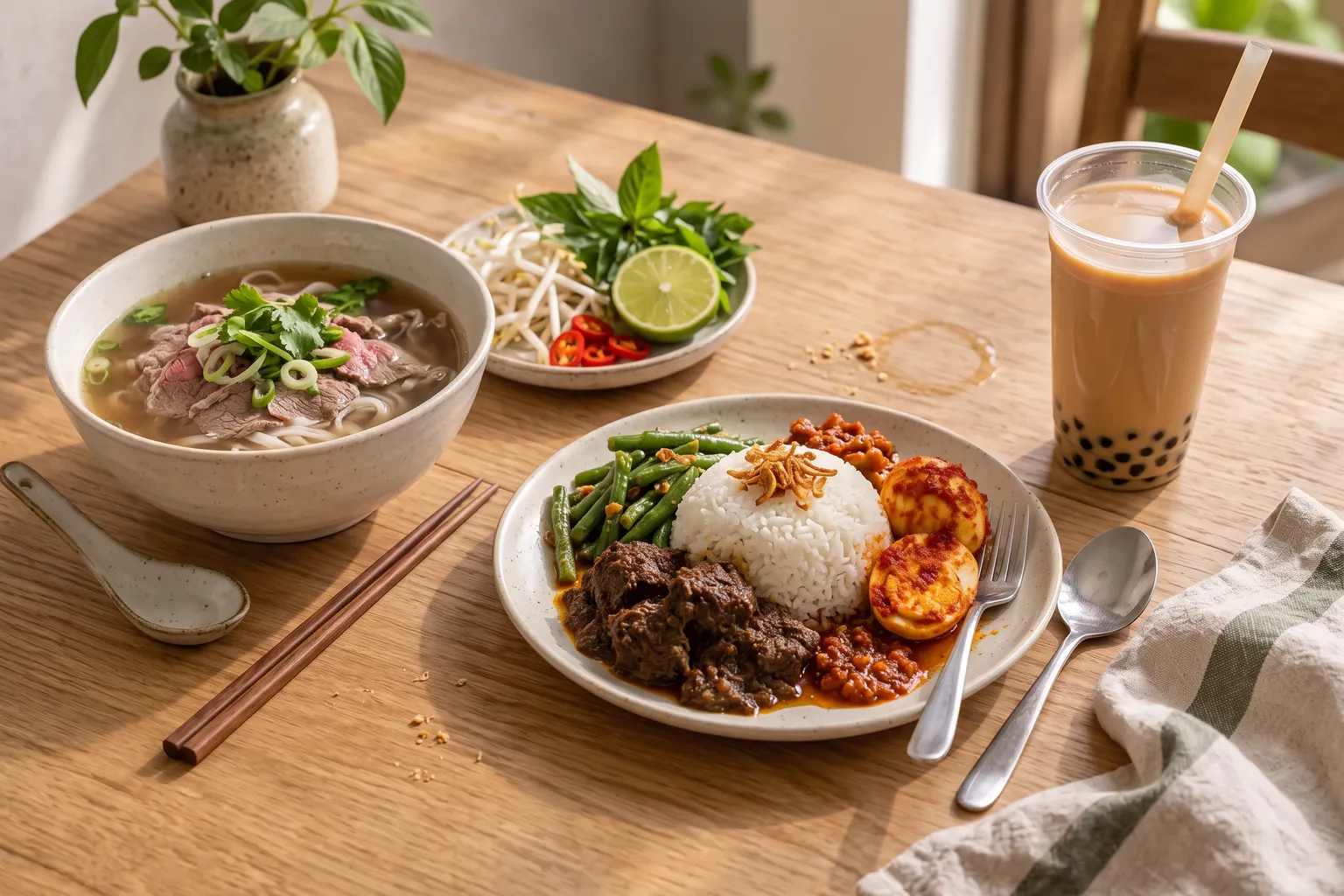
If your everyday food is a bowl of pho, a plate of nasi campur or a curry with rice, you may have noticed that calorie apps seem less sure of themselves than they do with a sandwich. That is not your imagination. When researchers have tested these apps, mixed dishes are where they go most wrong, and dishes from outside Western food culture often fare worst.
In short: a mixed dish hides most of what a calorie estimate needs to know. The parts are mixed together, the oil and sauce are out of sight, and the dish may not be in the app's database at all. You cannot make the estimate exact, but you can make it more useful.
What one study measured
In 2024, a team at the University of Sydney evaluated 18 popular nutrition apps [1]. They entered the same three days of food, a Western diet, an Asian diet and one based on Australian dietary guidelines, into the apps that log food manually. They then compared what each app reported with a reference analysis of the same food.
- Manual logging. For the Western diet, 14 of 16 apps overestimated energy, by an average of 1,040 kJ (about 250 kcal). For the Asian diet, it went the other way: 13 of 16 apps underestimated, by an average of 1,520 kJ (about 360 kcal). The gap was not only in the apps. The researchers' own reference database lacked some of the Asian foods, so they took values from supermarket websites, and for pearl milk tea from the shop's website. They also point to earlier research in which users named missing local foods as a main barrier to using nutrition apps.
- Photo recognition. Seven apps could recognise food from a photo. Their success at naming the individual components across 22 images ranged from 46% to 97%. Four of them also estimated energy from the photo.
- Mixed dishes were the weak point. On eggs on toast, one app missed the butter, and its estimate came out 35% low. For beef pho and pearl milk tea, the apps did not identify the separate components, and energy was underestimated by up to 76%.
What it cannot tell you. The photos were taken in good light, with no clutter, at a fixed distance and angle. The authors say real-life photos are likely to vary more. Only the free versions of the apps were tested. And apps change: these were the versions available in 2024. The study shows where the difficulty lies, not how any app performs today.
Why mixed dishes are hard
A separate study of people who keep food diaries, from 2015, surveyed 141 current and former journalers and read 5,526 posts on three food-tracking forums [2]. Respondents rated packaged food the easiest thing to log (6.5 on a seven-point scale) and fast food next (6.3). Home-cooked meals scored 4.6, "ethnic food" 3.7, restaurant meals 3.6, and food at a party 2.9.
The reasons they gave line up with the Sydney results. A mixed dish leaves you unsure of four things at once:
- The ingredients. What is actually in the broth, the sambal, the curry paste?
- The proportions. How much meat, how much noodle, how much oil?
- The preparation. Was it fried, or cooked in coconut milk? Was butter stirred in at the end?
- The portion you ate. A bowl of soup can be mostly broth or packed with noodles.
The researchers' conclusion was that uncertainty about any one of these makes the whole entry less reliable. Some participants said that, rather than struggle, they started eating the same foods or avoiding food that was hard to log. That is the opposite of what a food diary is for.
A camera has the same four problems, plus one of its own: it sees only the surface. Oil soaked into rice, sugar dissolved in a drink, and coconut milk in a sauce leave little trace in a photo. We cover the camera's limits in more detail in How accurate is a photo calorie estimate?
How to log a mixed dish better
None of these steps makes the number exact. They make it closer, and more consistent from one week to the next, which is what lets you see a pattern.
- Log the parts you can name. "Rice, beef rendang, cabbage, sambal" tells you more than "nasi padang". If an app returns one vague item, split it.
- Log the drink as its own item. In the Sydney study, pearl milk tea was one of the two items whose components the apps failed to identify. A drink logged as "tea" can hide the milk, the sugar and the pearls.
- Add what the photo cannot see. If you know the dish was fried, came with extra sauce, or had a spoon of oil on top, add it.
- Take the photo at an angle. The Sydney authors note that photos taken at 45 to 60 degrees help recognition and portion estimates. A view from directly above flattens a bowl.
- Correct the guess, then reuse it. If you eat the same dish from the same stall every week, fix the entry once, then log that version every time. A consistent estimate is more useful than a different guess each time.
- Read the week, not the meal. One entry can be well off. Errors in a week of meals partly cancel out, and patterns tend to survive.
How Senumi handles mixed dishes
Senumi was designed around exactly the kind of meals these studies found hardest. It does not solve the problem. It makes it easier to work with.
- One photo, separate items. A scan returns the foods it finds on the plate as a list, each with its own portion estimate, rather than one name for the whole meal.
- You confirm before anything is logged. Untick what is not there, rename what is wrong, change a portion. Your corrected version is what enters your history. Why we ask you to confirm every scan explains the reasoning.
- Describe what the photo cannot show. You can type the meal in a sentence, such as "pho with extra noodles and a sweet iced coffee", and get an itemised estimate back, with the same confirmation step.
- Dishes named in your language. The 502 original dishes in Senumi's catalogue have names in all of its app languages, and the catalogue can be browsed by the cuisine of the country you are in.
- Estimates are labelled as estimates. Senumi cannot see oil soaked into rice or sugar dissolved in a drink any better than any other camera. It says when a figure is a guess.
Senumi was not one of the apps in the Sydney study, and we have not tested it against the same reference meals. We are not claiming it beats the apps in the study. What we are claiming is narrower: a list you can check and correct is a better record of a mixed dish than a single number you have to take on trust.
Food and portion figures from any app, Senumi included, are estimates. Never use them for allergy decisions or medication dosing, insulin included. If a number matters for your health, ask your doctor or a dietitian.
Sources
- Li X, Yin A, Choi HY, Chan V, Allman-Farinelli M, Chen J. Evaluating the quality and comparative validity of manual food logging and artificial intelligence-enabled food image recognition in apps for nutrition care. Nutrients. 2024;16(15):2573.
- Cordeiro F, Epstein DA, Thomaz E, Bales E, Jagannathan AK, Abowd GD, Fogarty J. Barriers and negative nudges: exploring challenges in food journaling. Proc SIGCHI Conf Hum Factor Comput Syst. 2015:1159–1162.
This article is general health information, not medical advice. Senumi does not diagnose, treat, cure or prevent any condition. Talk to a qualified healthcare professional about your own situation.