Holiday eating: what the scale studies actually show
The holiday season is shorter than it feels. What researchers found when they weighed people before and after, and why a rough food log beats a paused one.
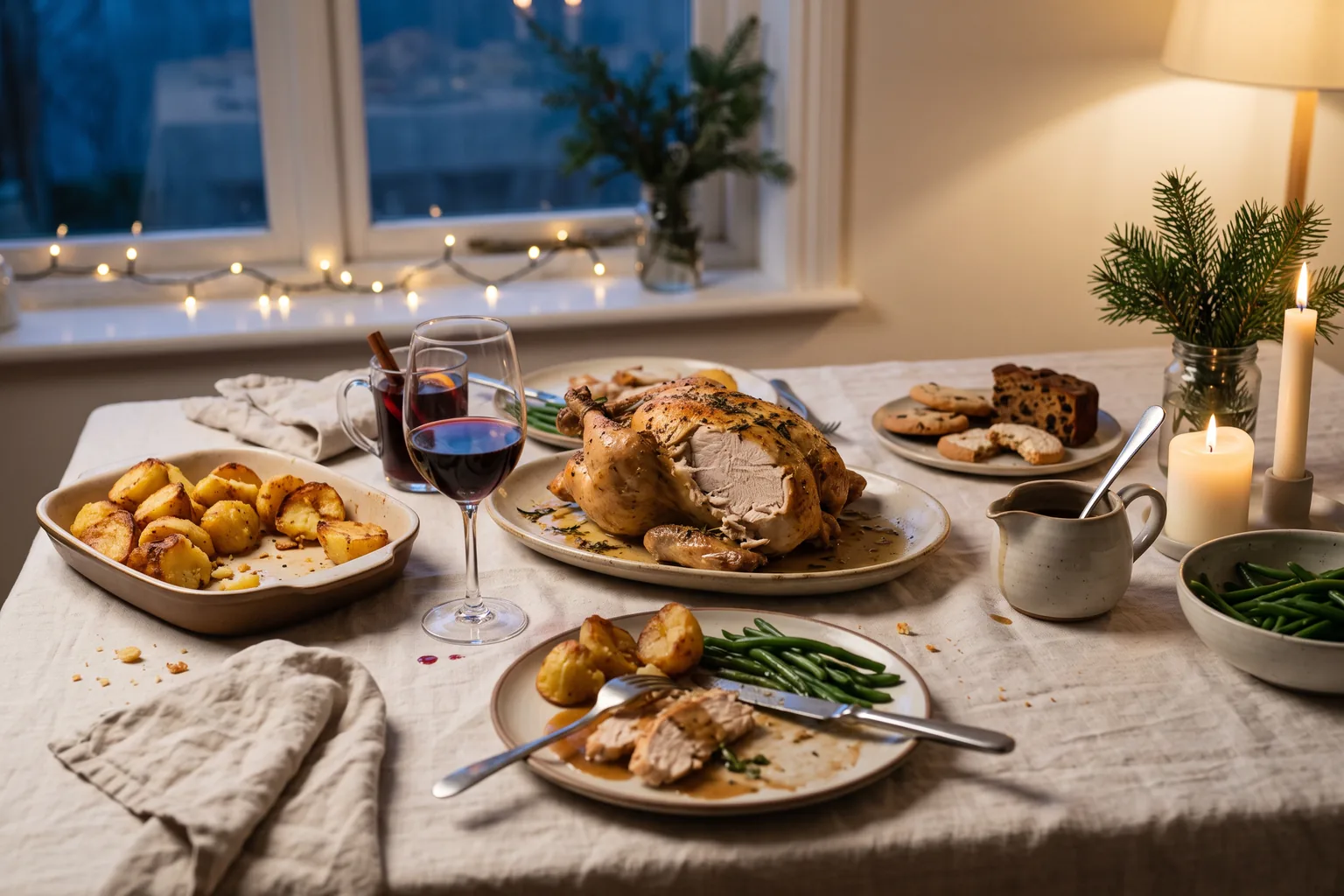
From late November to the new year, the calendar fills with dinners, office parties, family visits and food that only appears once a year. It is also when many people stop logging their food, on the reasoning that the holidays "don't count" and they will start again in January.
In short: when researchers actually weighed people, the average holiday change was smaller than most people expect, but part of it stayed. The season is a few weeks long, and a rough record kept through it is worth more than a perfect one that stops.
What the studies measured
Most of what people say about holiday eating is a guess. A few studies replaced the guess with a scale.
- United States, 1999–2000. Researchers at the US National Institutes of Health weighed 195 adults four times, six to eight weeks apart, from late September to early March [1]. Over the holiday period, mid-November to early January, the average weight went up by 0.37 kg, well under the 2.3 kg (5 lb) often claimed. Before and after the holidays, the change was not significant. But the gain was not reversed in spring: the 165 people weighed again the following autumn had not lost it.
- Three countries, 2016. A study of 2,924 adults who weighed themselves daily on smart scales in the United States, Germany and Japan found weights about 0.5% higher ten days after Christmas than ten days before, in all three countries [2][3]. Other holidays showed smaller rises of about 0.2% to 0.3%: Thanksgiving in the United States, Easter in Germany and Golden Week in Japan. People kept about half of the holiday gain afterwards.
What it cannot tell you. These were averages from a few countries, from people who agreed to be weighed or who owned a smart scale. Averages hide a wide spread: some people gain more and some gain nothing. And a short-term change on a scale can include water and food not yet digested, not only body fat. The studies describe what happened to groups of people, not what will happen to you. One of the 2016 study's three authors, Brian Wansink, later had other papers retracted. This letter has not been retracted, and its weights were recorded automatically by the scales.
Why the season adds up
A single big dinner is not the issue. It is the run of them: the extra plate at a party, the tin of biscuits at work, the sweet drinks, a few weeks of later nights. The changes are small, they arrive together, and the gap is easy to underestimate. Earlier articles cover two reasons why: restaurant meals are harder to judge than meals at home, and so are the drinks that come with them.
It is also the time of year a logging habit is most likely to break. In a small study of people forming new health habits, weekends and holidays disrupted their routines, because the cues they relied on (a commute, a desk, a set lunch hour) were gone [4]. The habits came back when normal life did. That is reassuring, but it also explains why "I'll start again in January" so often becomes February.
Does keeping track help?
One trial tested a light-touch approach during the holidays. In Birmingham, UK, 272 adults were randomly given either a healthy-living leaflet or a short programme for the Christmas period: weigh yourself regularly and write it down, some practical tips, and pictures showing how much walking it takes to use the energy in common festive foods and drinks [5]. The group given the programme was, on average, 0.49 kg lighter at follow-up than the leaflet group. The programme asked for attention, not a diet.
That study tracked weight, not food. But it points in the same direction as the logging research: noticing is the part that matters, and it does not need to be exact.
A simple way to get through the season
The aim is not to log every holiday meal precisely. It is to keep the habit alive through a few unusual weeks.
- Keep logging, but lower the bar. "Christmas dinner, big plate, two desserts" is a useful entry. A blank day tells you nothing.
- Log one photo per event. At a party or a buffet, one picture of your plate is enough. Add a note for the second round.
- Count the drinks. Mulled wine, eggnog, sweet coffee drinks and soft drinks at a party add up quickly and are rarely remembered the next day.
- Notice the days, not just the dinners. Holiday weeks often bring snacking between meals and a late breakfast that becomes brunch. A quick note at the end of the day catches most of it.
- Do not save it all for January. If you skipped a week, start again with today's meal, not with a new plan.
- Leave room for the food that matters to you. Holiday food is part of the holiday. The 80/20 approach is a way to enjoy it without losing track of the rest of the week.
How Senumi helps
- One photo per plate. A scan comes back as a list of separate items with portions, so a buffet plate takes a few seconds instead of a few minutes.
- Type it when there is no photo. "Two slices of roast turkey, potatoes, gravy and a glass of red wine" gets an itemised estimate back.
- Check before it counts. Remove what you did not eat, change a portion, add the dessert. Nothing enters your history until you confirm.
- See the week, not just the day. A big dinner is one day. History shows how the whole week went, which is the picture that matters over a season like this one.
Food and portion figures from any app, Senumi included, are estimates. Never use them for allergy decisions or medication dosing, insulin included. If you need precise numbers for a health reason, ask your doctor or a dietitian.
Sources
- Yanovski JA, Yanovski SZ, Sovik KN, et al. A prospective study of holiday weight gain. N Engl J Med. 2000;342(12):861-7.
- Helander EE, Wansink B, Chieh A. Weight gain over the holidays in three countries. N Engl J Med. 2016;375(12):1200-2.
- Harvard Health Publishing. Holiday weight gain is a worldwide phenomenon, study suggests. 14 November 2016.
- Lally P, Wardle J, Gardner B. Experiences of habit formation: a qualitative study. Psychol Health Med. 2011;16(4):484-9.
- Mason F, Farley A, Pallan M, et al. Effectiveness of a brief behavioural intervention to prevent weight gain over the Christmas holiday period: randomised controlled trial. BMJ. 2018;363:k4867.
This article is general health information, not medical advice. Senumi does not diagnose, treat, cure or prevent any condition. Talk to a qualified healthcare professional about your own situation.